
Case Studies
Sports Betting Link Building Case Study: How 49 Guest Posts Turned a −64% Slide Into +84%
By Velichko AchevPublished 6 min read
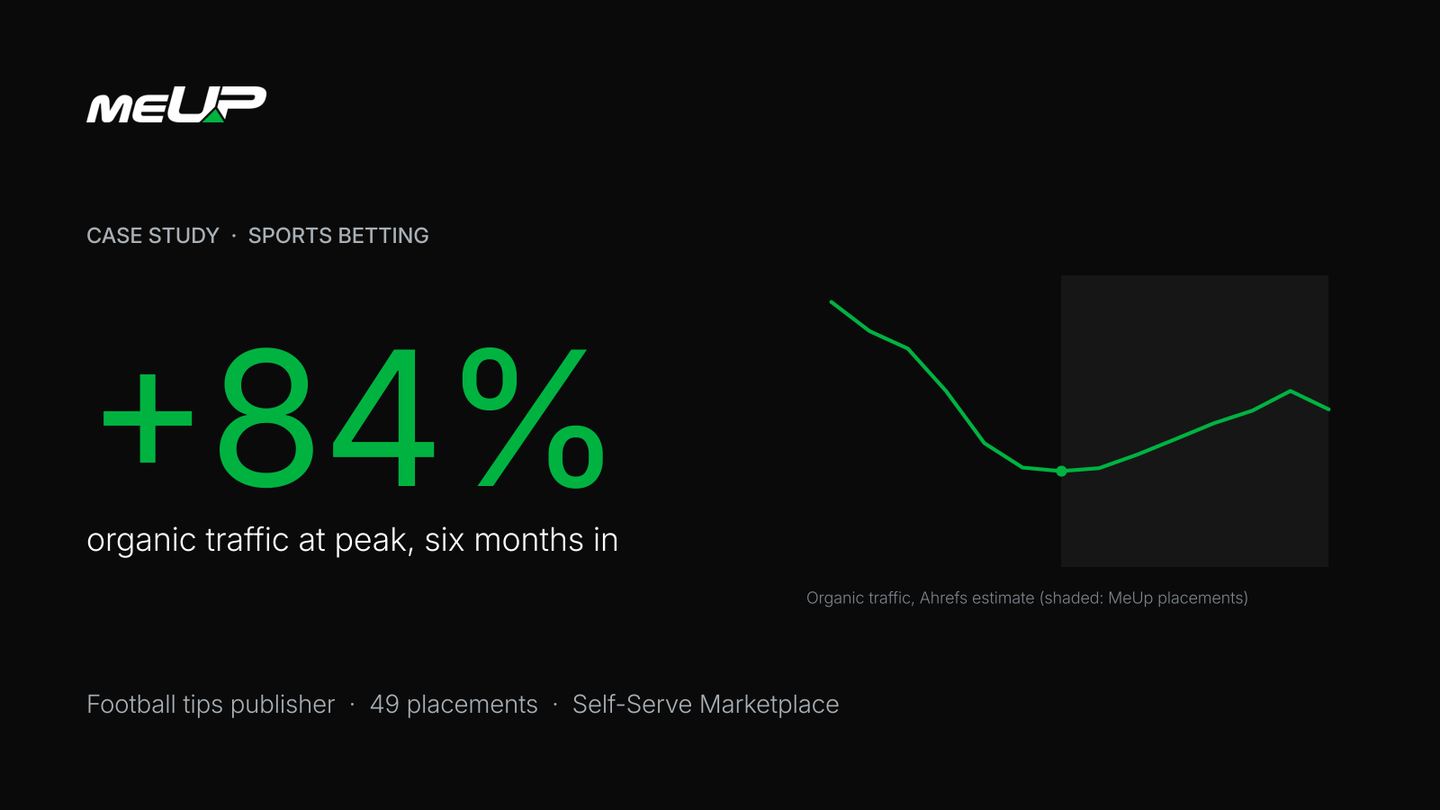
- organic traffic in six months
- +84%
- traffic to the betting-tips section
- 11×
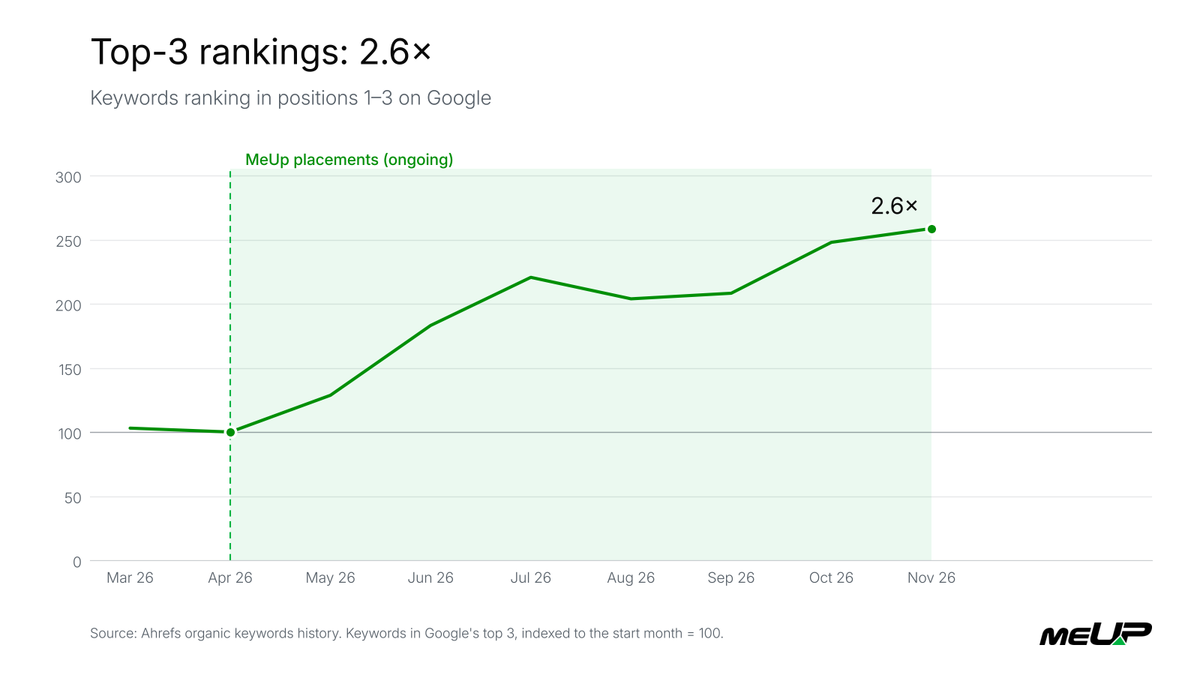
- keywords in Google's top 3
- 2.6×
Short version: a big football tips and betting site lost almost two-thirds of its organic traffic over the winter. In April 2026 its in-house team started a sports betting link building campaign through MeUp's Self-Serve Marketplace. Seven months and 49 placements later, organic traffic was up 84% from the low point, and the section that got the most links was up 11×.
Here is what they did, which pages moved, which didn't, and why we think it worked. Everything below comes from our order records and Ahrefs. The client and the publishers stay anonymous, so we describe articles and anchors rather than quoting them.
The situation
Between October 2025 and April 2026, organic traffic fell about 64%. We don't know the full cause, and we won't guess at it. What matters for this case: this was not a young site. It already had over 5,000 referring domains and a Domain Rating in the low 40s.
So the question was never 'how do we get more links'. It was 'which links, pointing at which pages, will move the pages that make money'. That is a different brief from building a new site's authority, and it changes almost every decision below.
The playbook
1. Get momentum with link insertions
April started with three links added to existing, already-indexed articles on betting sites, pointing at the Premier League tips page, a betting strategy guide and the betting sites hub. Link insertions go live fast and pass value from pages that already have authority, so they get things moving while the guest posts are being written. From May onwards, all 46 remaining placements were guest posts.
2. One article, one betting market, one target page
This is the core of the campaign. For almost every betting market the site has a tips page for, the team wrote a matching explainer and placed it on a tipster or prediction site:
- An explainer on how correct-score betting works → the correct-score tips page, with a descriptive anchor about correct-score tips
- An explainer on card betting → the card betting tips page
- The same pattern for both-teams-to-score, over 1.5, 2.5 and 4.5 goals, clean sheets, anytime goalscorer and accumulators
- Payment-method guides (bank transfer, PayPal, deposit options in general) → the matching deposit-method pages
- Guides to UK licensing and licensed bookmakers → the betting sites hub
Why this works: the article, the anchor and the target page are all about the same thing, and the publisher's readers are the same punters the client wants. To Google, each link looks exactly like what it is: a relevant reference from a page about a topic to the best page on that topic.
3. Ride the football calendar
Football search demand is seasonal, and the team planned around it. Four World Cup 2026 pieces (outright predictions, the bookmakers' favourites, the most interesting tournament markets) went live in late June, all pointing at the World Cup tips page.
In August and September, as the new season kicked off, a run of club-by-club season previews went out on club and fan sites, each covering odds and best bets for one team. They pointed at the Premier League, Scottish Premiership and Europa League tips pages, right when people start searching for them again.
4. A layer of brand signals
About one in five placements were brand plays rather than keyword plays: head-to-head comparisons between the client and other tipster sites, two hands-on '90 days with the site' reviews, and a few straight brand mentions linking to the homepage. They build brand search and entity signals and keep the anchor profile natural.
Which publishers they picked
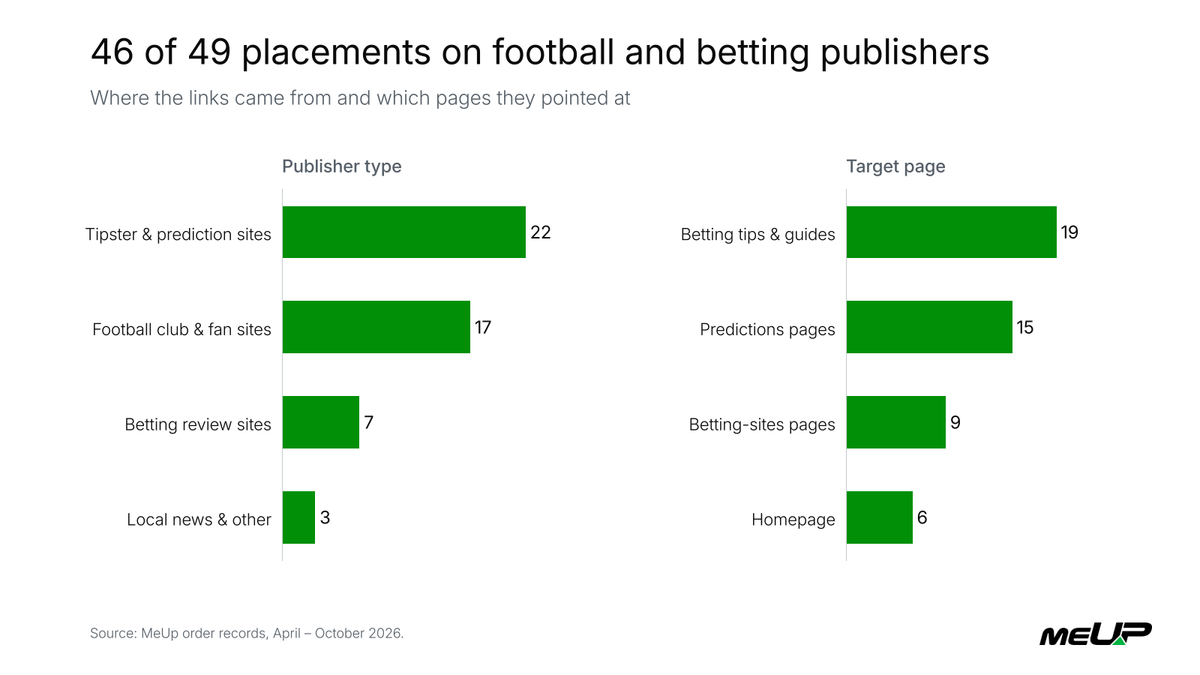
Two things stand out.
Relevance first. 46 of the 49 publishers are football or betting sites: tipster and prediction sites (essentially peers), club and fan sites, and betting review sites. The other three were two UK local news sites and one general site, and even those articles were about football or betting.
Traffic over DR. The median publisher DR was 34. 19 of the 49 were under DR 30 and only 8 were DR 50+. But the median publisher had around 11,000 organic visits a month, and 28 of 49 had over 10,000. Several tipster sites in the set sit under DR 20 but get tens of thousands of visits a month, one of them well over 100,000. Filter by DR alone and you would throw them out (more on that in our take on Ahrefs Domain Rating).
Anchors and content
- Anchors: about 71% descriptive keyword phrases, usually long and natural (the market or payment method plus a word like tips or sites), 22% branded or brand plus keyword, 6% generic. Almost no exact anchor repeats.
- Why they could be that keyword-heavy: the site already had 5,000+ referring domains. 35 keyword-led anchors are a rounding error in a profile that size. On a new site with 50 referring domains, we would go much more branded.
- Content: 46 articles written by the client's own team, all in English, most with a UK angle, 548 to 1,562 words (median about 780).
- Format: almost every article opens with a one-sentence definition of the market or topic before going deeper. It reads well, and it is the kind of opening that gets quoted in featured snippets and AI answers.
- Cadence: 3, 8, 12, 6, 10, 7 and 3 placements per month from April to October. Steady, no spikes, no gaps.
Results
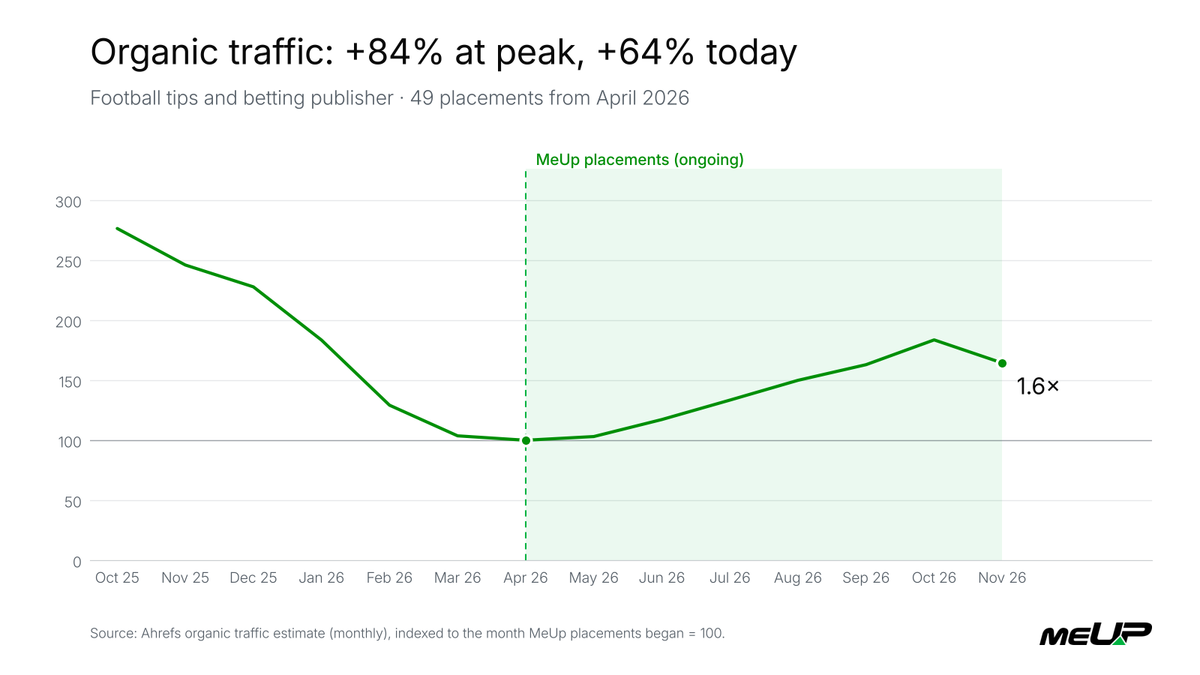
Across the whole domain, organic traffic rose 84% from April to the October peak and sits 64% above the starting point today. Keywords in Google's top 3 grew 2.6× and Domain Rating went from 44 to 52.
The more interesting picture is page by page:
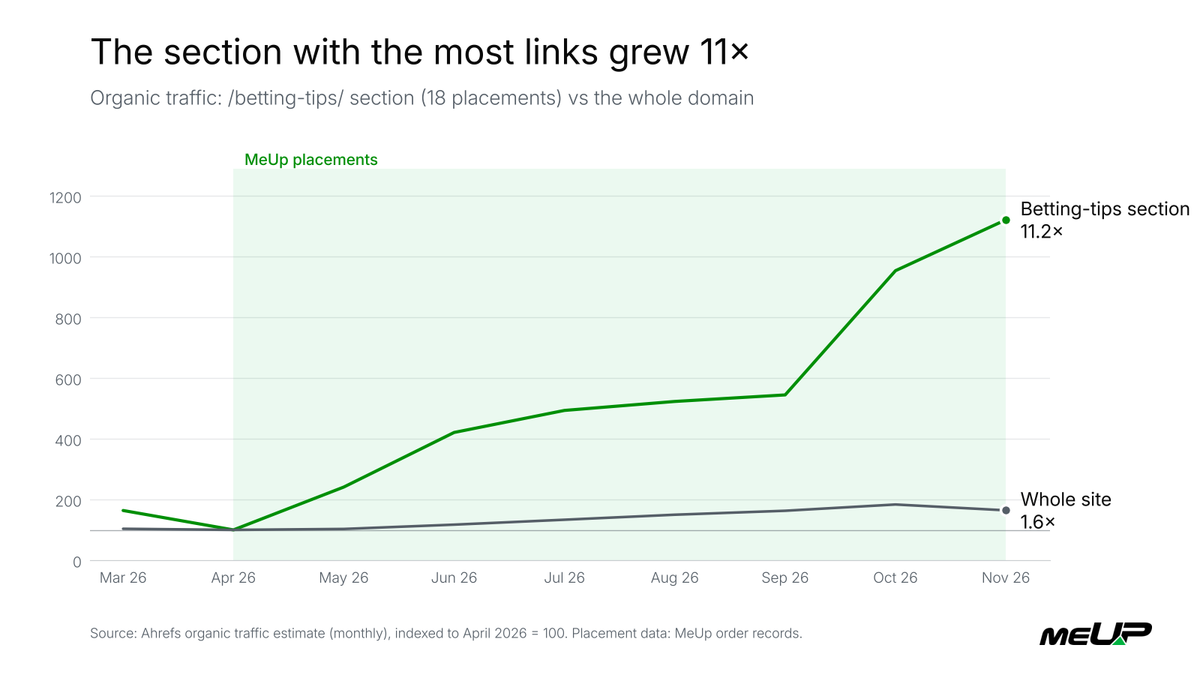
- Betting-tips section: roughly 4,000 to 45,000 monthly visits (11×). It got 18 placements, more than any other section.
- Correct-score tips page: from about 650 to 22,000 monthly visits. To be fair, it had started rising in May, before its own link in June, probably helped by links to the rest of the section. It kept climbing after.
- Both-teams-to-score tips page: about 200 to 1,900 monthly visits, with the lift starting a month or two after its link went live at the end of July.
- World Cup tips page: from under 150 visits a month to 5,000 to 7,000 during the tournament. Most of that is tournament demand, as the links went live mid-tournament. We include it because planning content around the calendar is part of the playbook, not as proof the links did it.
- Premier League tips page: dipped in the summer break as usual, then came back above 20,000 monthly visits once the season started, after the run of season previews.
What didn't move
- Accumulator tips page: one guest post, no measurable change. One link into a very competitive market is not enough on its own.
- Commercial 'best betting sites' pages: up from about 40 to under 1,000 visits a month at best. Those results are dominated by the big comparison portals, and nine links do not change that.
Why we think it worked
- Topical density. Nearly every link came from inside football and betting, from sites whose readers are the same punters.
- Page-level targeting. Links went to the pages that rank for money queries, and each article matched its target page's topic one to one.
- Timing. Season previews went live as the new season kicked off, exactly when searches for tips pick back up.
- Consistency. Seven months of steady placements, never more than 12 in a month.
- An existing base. With 5,000+ referring domains, the site didn't need raw authority. It needed authority pointed at the right pages.
The honest caveat: Ahrefs traffic is an estimate, and we can't rule out other factors such as on-page work or Google updates. But the site's total referring domains grew only about 8% over the period, so these 49 placements are most of the new link signal. And the pages that got links are the pages that grew.
For a different angle on the same vertical, see our multilingual sports betting affiliate case study and our iGaming link building case study.
Want this done for you?
This client ran everything in-house on our Self-Serve Marketplace: planning the market-by-market content, writing 46 articles, choosing publishers and placing every order. If you'd rather spend that time elsewhere, our Managed Accounts team runs the same playbook for you: content plan, publisher selection, writing, placement and monitoring. From $3,000 a month, with 0% service fees.
Same publishers. Same monitoring. Same replacement guarantees. Same team behind it. The only question is how much of the execution you want to own.
See Managed Accounts, read our Self-Serve vs. Managed guide, or browse betting-friendly publishers yourself on our sports betting backlinks page.
How we measured this: organic traffic, keyword and Domain Rating figures are Ahrefs estimates, read monthly and indexed to the month the first MeUp placement went live. Placement counts, publisher Domain Ratings and dates come from MeUp's order records. Client names and domains are withheld; growth figures are rounded.
Common questions
Do guest posts still work for sports betting sites?
Should betting backlinks come from high-DR sites?
How many keyword anchors are safe for a betting site?

Velichko Achev
CEO, MeUp
Founder and CEO of MeUp. Velichko leads MeUp’s strategy and marketing and writes about link building, SEO metrics and running campaigns in competitive niches.
Build links with MeUp
Related reading
Case Study
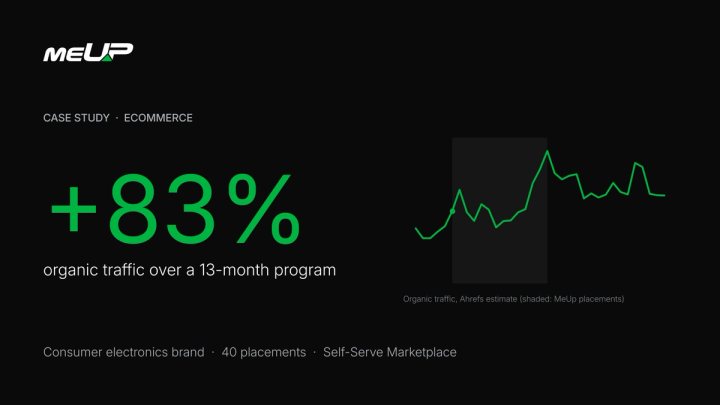
Ecommerce Link Building Case Study: +83% Organic Traffic With Lifestyle-First Guest Posts
40 lifestyle-first guest posts, every link to a category page, no branded anchors. How a consumer electronics store grew organic traffic 83%. Ahrefs data.
Case Study
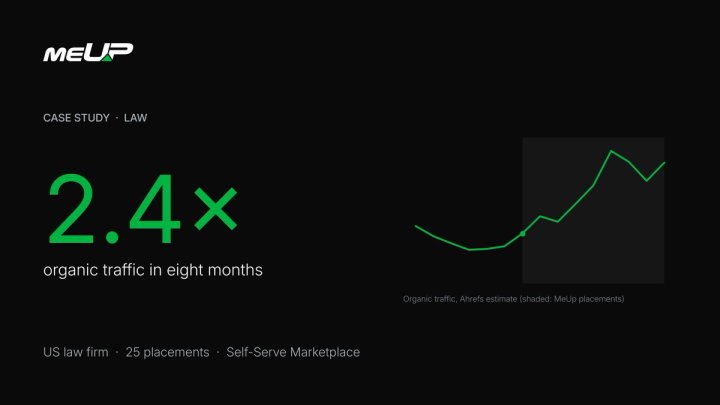
Law Firm Link Building Case Study: 2.4× Organic Traffic With Local, Long-Form Guest Posts
25 long-form legal guest posts aimed at county-level service pages. How an agency helped a US criminal defense firm grow organic traffic 2.4× in 8 months.

Case Study
eSports Link Building Case Study: How 4 Guest Posts Got a New Dutch Site Ranking
eSports link building case study: four high-authority guest posts took a Dutch eSports site with no traffic or backlinks to steady rankings and traffic.